 eleticle

Can a local 27B model find the right historian tags from a plain question?
Qwen 3.8 27B on one machine · the Pi agent harness · No. 18’s stand-in historian, catalogue and tools · 24 questions written by Codex · 3 fresh sessions each · every answer read
We gave a local 27B model the catalogue tools and skill built in No. 18 and asked it 24 questions a metallurgist might type about a 50,594-tag historian, three times each, with the answer key out of its reach.
What we found
- Right tags68 of 72 attempts met every rule fixed before the runs; the four misses left a dead tag unmentioned among the readings a vague question could mean.
- Dead tags called deadAsked for a broken or stale reading, it said so in all 12 attempts and never passed off an old or missing value as a reading; most offered a healthy alternative.
- Vague questionsAsked for “mill power at Site J” or “gold grade”, it set out several candidates with their values rather than silently picking one, though not always every kind of reading that could be meant.
- Tags right, numbers not alwaysThe rules scored the tags. Seven answers quoted a mean from our tool that was 1 to 24 % off: it averaged the other summaries asked for (minimum, maximum, total or count) in with the hourly averages (now fixed). One ranking misled on its own. A median of 33 seconds a question.
Method
Fresh sessions, a fixed key, every answer read
- ModelQwen 3.8 27B, on site4-bit weights on this machine’s GPUs, in the Pi agent harness (1.5.2); No. 18’s eight MCP tools over HTTP with a key, its skill for finding tags, and Python with pandas and matplotlib for charts.
- Stand-inNo. 18’s historian31 sites × 5 concentrators, 50,594 tags on real hourly flotation and plant records with generated records inside each hour, faults planted on purpose. The historian’s clock: 23 Nov 2026, 00:00.
- Questions24, written blindWritten by Codex from a description of the plant, without the tools, skill or catalogue, given six point codes and eight dead tags to ask about: four each of one reading, two together, highest or lowest, could mean several, a code from a screen, and a reading whose tag is dead.
- ScoredA key before the runsThe right tags from the plant generator, the winners from the historian’s own summaries; pass or fail by written rules; every attempt in its own sandbox, the key and other attempts’ answers out of sight (the run’s dataset files were shared); all 72 answers read.
Limits: one model, one stand-in historian whose tags are tidier than most sites’; 20 of the 24 questions name a site (the four code questions give only a code); three repeats. Times were taken on a machine also running other work (tests, key builds), so they are indicative. In the stand-in a calculated copy of a stale tag stays healthy, which a real historian’s usually would not, and in all three sessions of one question the agent used one. The questions, key, rules, run script, every tool call and answer, and the verdicts: the article’s public repository.
01 · Every attempt
Six kinds of question, three sessions each
One square per attempt: a question asked in a fresh session, scored against the key. A pass needs the right tags read, a dead tag called dead, and, for a vague question, the options set out rather than one picked.

Six questions touched a dead tag they had not asked about (a stale belt current, a stale cyclone pressure, an energy meter with no data, a broken ball mill power, a broken water meter, two dead reagent tank levels), and the rule said it must be called out. The four failures: all three tank-level answers never mentioned the two dead tank levels, and one mill-power answer said no tag was unusable. The one that misleads: asked which area used the most energy, one session named flotation “by far the most” among the meters that could be read and flagged grinding’s dead meter; it passes the rule, but grinding’s power tag, which the other two sessions used, shows about three times as much.
02 · Step by step
What the agent did, and what it said
Most answers start the same way: read the historian’s clock, find the place, search within it, read only the chosen tags. Pick a question to see its calls and the start of its answer.
-
Question 03 · One reading · repeat 1 · 29 s
“Trend yesterday's SAG fresh feed tph for Site D, Conc 1.”
What it did · 7 calls- clock
- find place
Site D concentrator 1 - known tags
- search
SAG fresh feed rate - read series
1 tag - read file
- python
plots the dataset file
What it saidChart saved to sag_fresh_feed_tph_2026-11-22.png in the current folder. SAG fresh feed trend — Site D, Concentrator 1, yesterday (22 Nov 2026) Tag: \\EXAMPLE-AF\Operations\Example Mining\Site D\Concentrator 1\Grinding\SAG Mill · Fresh Feed Rate (point SD1:2WT001, catalogue id 4596) — primary, healthy, t/h. This is the golden throughput tag for this concentrator. Basis: time-weighted hourly averages, 24 hours, …
✓ Read the SAG fresh feed rate at Site D, Concentrator 1 for 22 Nov and saved a chart. Its daily mean of 339.8 t/h is the tool’s, which averaged the hourly totals, minimums and maximums in with the hourly averages; those averages alone give 446.5.
-
Question 12 · Highest or lowest · repeat 1 · 66 s
“Site O, Conc 4 — which of the four area power meters clocked up the most kWh yesterday?”
What it did · 8 calls- clock
- find place
Site O concentrator 4 - known tags
- search
area power meter energy - read series
4 tags - read series
1 tag - read series
1 tag - python
plots the dataset file
What it saidGrinding (PM3) clocked up the most — ~305,150 kWh yesterday (22 Nov 2026, AEST), well ahead of the other three area meters: · Area meter · kWh (22 Nov) · Share · · --- · --- · --- · · Grinding Supply (PM3) · 305,150 · 69% · · Flotation Supply (PM4) · 97,510 · 22% · · Leach Supply (PM5) · 29,285 · 7% · · Crushing Supply (PM2) · 8,645 · 2% · · Four-area total · 440,591 · · Sanity check: the Main Incomer energy counter …
✓ Said grinding’s energy counter has no data and worked out grinding’s energy from its power tag: grinding the most.
-
Question 13 · Could mean several · repeat 1 · 49 s
“What's mill power doing at Site J this morning?”
What it did · 9 calls- clock
- find place
mill at Site J - find place
Site J - known tags
- search
mill power - read series
5 tags - read series
5 tags - read file
- python
plots the dataset file
What it saidChart saved to site_j_mill_power_morning.png in the current folder. Mill power at Site J, this morning (22 Nov 2026, 00:00–09:00 AEST) Site J has 5 concentrators, each with one SAG mill — the big grinding mill. The headline: Concentrator 2's SAG was down from midnight until 03:45, then started and ran up to ~6.7 MW by 08:30. The other four ran steadily all morning: · Mill · Point · Morning avg · Range · · --- · --- …
✓ Set out several mill power readings across the five concentrators instead of picking one, and flagged the broken one. With the historian’s clock at midnight, it took 22 Nov as “this morning” without saying so; the other two sessions said why.
-
Question 20 · A code from a screen · repeat 1 · 22 s
“What's SVC5_PP7_FLOW2 on right now?”
What it did · 6 calls- clock
- search
SVC5_PP7_FLOW2 - read now
1 tag - read series
1 tag - python
reads the dataset file - python
plots the dataset file
What it saidSVC5_PP7_FLOW2 is reading 540.4 m³/h right now (last record 2026-11-22 23:59:55 AEST, quality good). Provenance: - Tag: catalogue id 49643, point SVC5_PP7_FLOW2 at \\EXAMPLE-PI\SVC5_PP7_FLOW2 — an unlinked point (not in the asset tree), primary variant, health ok - Basis: latest historian value for "now"; chart shows time-weighted hourly averages over the last 24 h (2026-11-22 00:00–23:00 AEST), mean 576.2, min …
✓ Found the spare point outside the asset tree by its code and read it.
-
Question 24 · A dead tag · repeat 1 · 27 s
“Pull the SAG bearing pressure trend for Site R, Conc 5 since 9 Nov 2026.”
What it did · 5 calls- clock
- find place
Site R concentrator 5 - search
SAG bearing pressure - read series
2 tags - python
plots the dataset file
What it saidChart saved: sag_bearing_pressure_siteR_conc5.png (in the current folder). SAG bearing pressure — Site R, Concentrator 5, 9 Nov → 22 Nov 2026 Trend: The pressure sits around 107 kPa average over the window, ranging 37–146 kPa. It's fairly banded (oscillating with mill load) rather than drifting — no sustained rise or fall across the two weeks. Provenance: - Tag used: SAG Mill · Bearing Pressure Calc — point …
✓ Said the primary bearing pressure tag is stale with no values in the window and used its healthy Calc copy instead.
-
Question 06 · Two together · repeat 1 · 82 s
“At Site AC, Conc 4, plot Cluster 2 feed pressure alongside the number of cyclones open last week.”
What it did · 10 calls- clock
- find place
Conc 4 at Site AC - search
Cluster 2 feed pressure - search
cyclones open count - browse
- search
SAC-C4-PT-2023 - browse
- read series
2 tags - shell
head - python
plots the dataset file
What it saidChart saved: cluster2_feed_pressure_vs_cyclones_open.png (in .../runs/r1/t06/1/). Important caveat — the pressure series could not be plotted: - Cluster 2 Feed Pressure — \\EXAMPLE-AF\Operations\Example Mining\Site AC\Concentrator 4\Grinding\Cyclone Cluster 2 · Feed Pressure (point SAC-C4-PT-2023, kPa): health is stale, last reading 2026‑11‑10 06:15 AEST. I confirmed the historian returned 0 values for 16–22 Nov, so …
✓ Read both cluster 2 tags and said the feed pressure tag is stale, with no values last week; charted the count.
03 · Its chart
The agent’s own chart, and the same data redrawn
Asked to “trend yesterday’s SAG fresh feed tph for Site D, Conc 1”, the agent read the hourly averages into a file and drew this with matplotlib. Below it, the same file drawn in the site’s style.
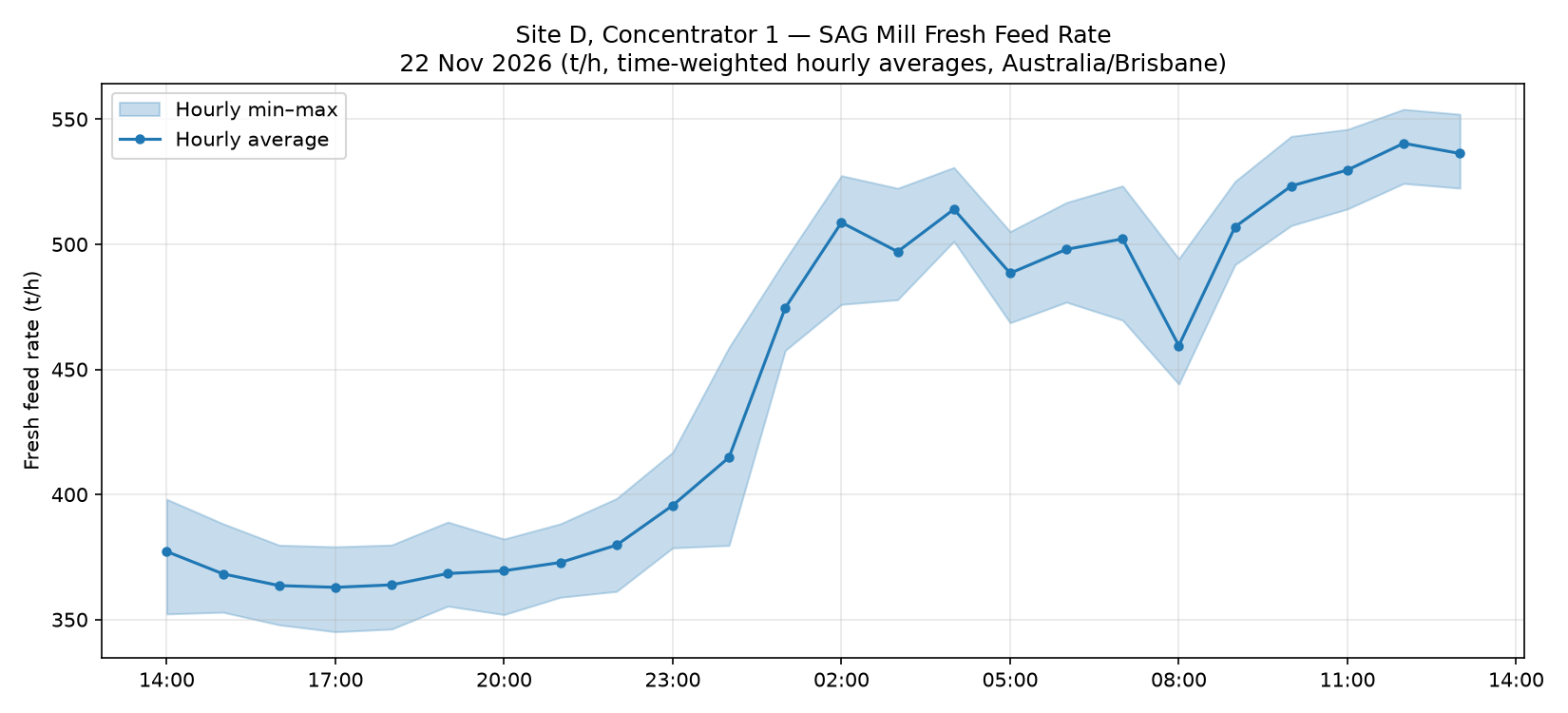

Two slips in this answer, one of them ours: the chart’s time axis is in UTC, because its date formatter was given no time zone, so midnight shows as 14:00 though the title says Brisbane time; and its text gives a daily mean of 339.8 t/h where the same file averages 446, a number our tool returned after averaging the hourly totals, minimums and maximums in with the hourly averages (fixed since). The plotted values are right: the redraw uses that file, in site time.
04 · Time per question
Seconds, not minutes
Wall time per attempt on one machine, from question to final answer, charts included. Five attempts took over a minute; the longest kept redrawing its chart.

05 · At your site
Before you trust an agent on your historian
- Write your own questions firstIn the words your people use, with the right tags noted beside each, before the agent sees any of them.
- Plant dead tags on purposeAsk for readings you know are broken or stale; an agent that reports zero for a dead tag is worse than none.
- Ask vague questions“Mill power”, “the tank level”: check it lists the options rather than picking one quietly.
- Run each question more than onceA fresh session each time; we ran three and checked the spread.
- Keep the key out of reachRun the agent where it cannot read your answer key, your scripts or its earlier answers.
Sources
- No. 18: How can a local agent find the right tag among 50,000? (the stand-in historian, catalogue, tools and skill used here).
- Qwen 3.8 27B, as 4-bit weights.
- Model Context Protocol specification. modelcontextprotocol.io/specification.
- Zyfra gold flotation record (the stand-in’s flotation values): the copy at github.com/5hraddha/zyfra-gold-recovery-prediction, commit 629470d8; not republished.