 eleticle

- Reading drawings and documents
- Documents and drawings
- Vision models
- Evaluation and benchmarks
- On-premises and edge hardware
Can a local LLM read a mineral processing plant flowsheet?
First test · two local models · four drawings · one attempt each · judged by eye
We gave two local models four flowsheet drawings, from a five-unit circuit to two whole plants, and asked each to redraw it as a Mermaid flowchart: plain text that still draws as a diagram. One attempt per model and drawing in the final set-up, judged by eye.
What we found
- 2 of 4drawings both models redrew correctly: the two simple ones
- 0 of 2whole-plant flowsheets either model got fully right
- 32close-ups of one plant drawing that Flash Next cut out and read. The 27B looked again at the whole drawing, once
- 14 minon average per whole plant for the Flash Next setup, which found more of the plant's loops. The 27B setup took about 2
Method
Four drawings, one instruction, two models
Most sites keep their flowsheets as PDFs or images. The labels in such a file can often be searched, but what connects to what stays locked in the picture: a model handed the drawing has to work out the connections again for every question. Read once into text and checked once by an engineer, the connections become something any model or program can use.
- DrawingsFour lecture slidesC. G. Anderson, Mineral Processing Flowsheets, Colorado School of Mines. Cropped to the figure, 200 dots per inch.
- JudgedBy eye, against the drawingUnits, connections and loops, each chart beside its original. A second reviewer checked every verdict.
- ModelQwen 3.8 27B2 × RTX 5080, 16 GB each, in a workstation. 4-bit weights.
- ModelQwen 3.8 Flash Next4 × RTX 3090, 24 GB each, in a server. Two copies of the model, with weights averaging 3.5 bits.
- Agent softwarePi coding agent 1.5.2Standard tools to read, write and run commands. No skill, no examples. One extension for the image limit.
The whole instructionThe attached image is a mineral processing flowsheet. Convert it to a Mermaid flowchart and save it as flowsheet.mmd in the current directory. Include every unit and every stream shown, with the labels as written on the drawing, and arrows in the direction of flow. The file must hold only Mermaid code.
Times, tokens, steps, boxes and lines are measured. Times compare the two complete setups (model, weights, server and hardware together), not the models alone. Tokens are input tokens summed over every request, so the conversation counts again each time it is resent. Verdicts and notes are judged by eye and checked by a second reviewer. The instruction, the scripts, the extension, each model's final Mermaid file and the numbers are in the article's public repository, where the serving software is also named. The repository does not include the drawings; a script rebuilds them from the lecture file.
01 · The result
Each model's chart against the original
Each model got one drawing and one paragraph: redraw this as a Mermaid flowchart, with every unit and every stream. Pick a drawing, then zoom and drag either side to compare. "Readable" opens a chart at full size.
- Correctevery unit and stream matches
- Partialmost labels right, several real loops, some reading and routing errors
- Poor connectionsunits found, most lines wrong
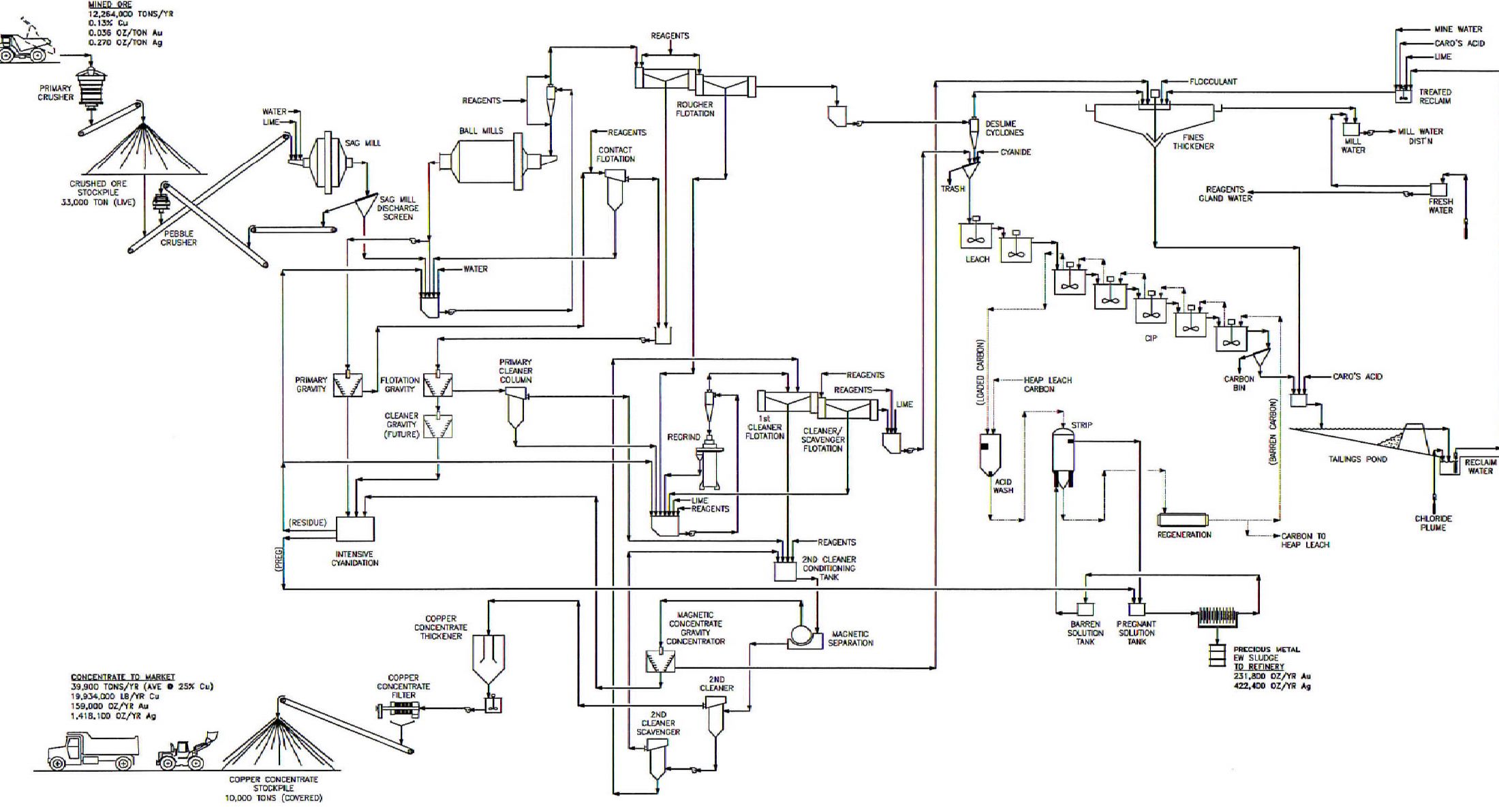
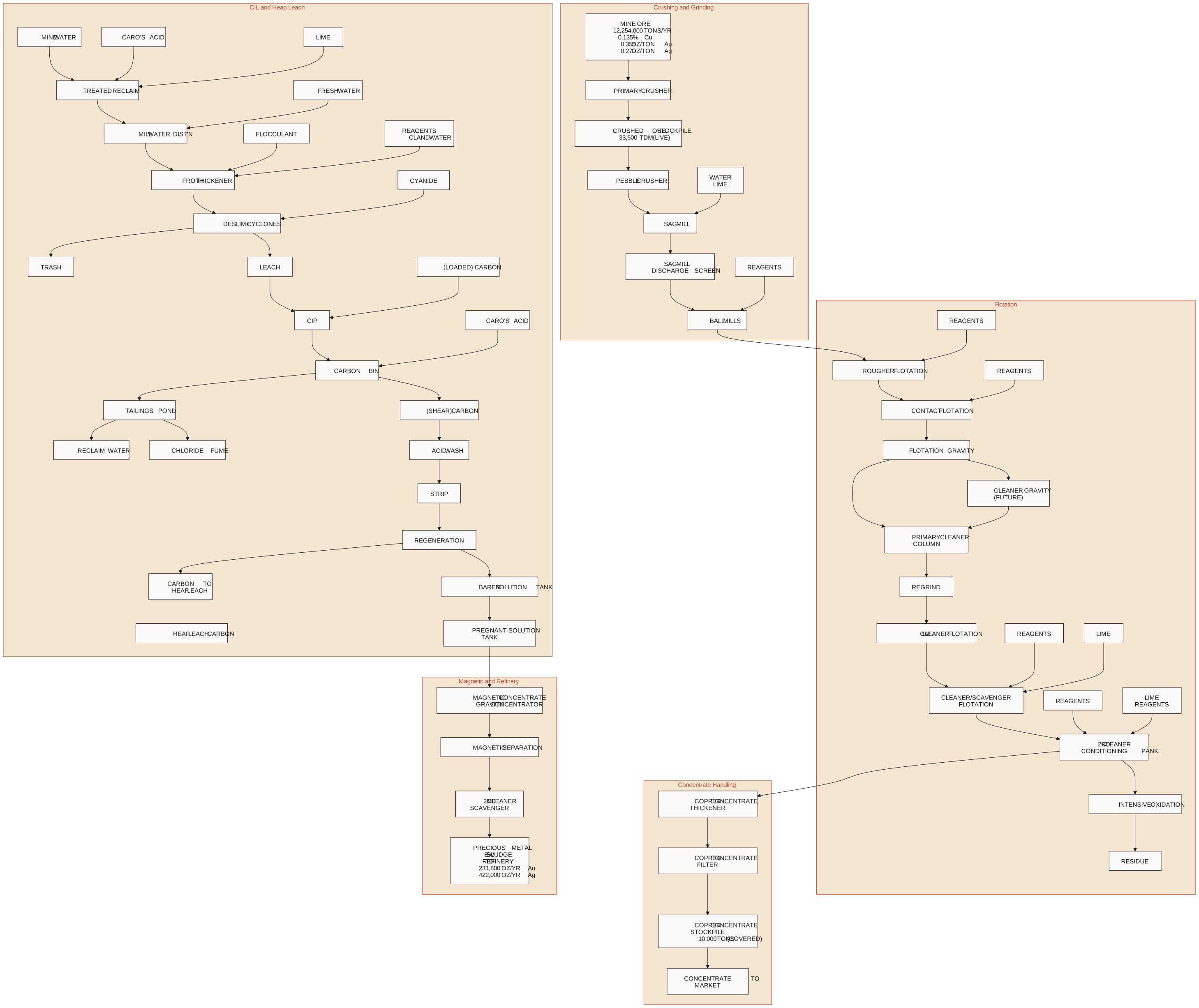
- RightMost unit names, in five tidy groups.
- MisreadIntensive cyanidation as "intensive oxidation"; fines thickener as "froth thickener"; chloride plume as "chloride fume"; the ore feed's gold grade as 0.355 oz/ton, about ten times the drawing's 0.036, and its tonnage and copper grade.
- MissingPrimary gravity, the 2nd cleaner, the electrowinning cell.
- WrongOne long chain: stockpile to pebble crusher to SAG mill and on. No pebble crusher recycle, no regrind loop, no carbon loop.

- RightThe unit names it kept, with the ore feed figures and the gold and silver sent to the refinery.
- RightLoops: pebble crusher on the SAG screen oversize; ball mill cyclones; carbon through acid wash, strip and regeneration.
- MissingThe regrind mill's cyclone loop; primary gravity; the tonnages and grades of the concentrate sent to market.
- WrongA "[GASES]" box that is not on the drawing.
Drawings: slides 23, 53, 39 and 37 of C. G. Anderson, Mineral Processing Flowsheets, Colorado School of Mines, each cropped to its figure. The charts are drawn unedited from the files the models wrote.
02 · How each model worked
One looked at the whole. The other kept zooming in
Same tools, no advice on using them. Each mark is one step, placed when it finished.
Small text needs a closer look
Flash Next wrote its own command to cut out one area at a time, enlarge it and read it. Nobody asked it to.
The closer look has a price
On this setup, fourteen minutes of a server the site already owns. Across a whole drawing register, that is a number to plan for.
03 · The set-up
Two fixes to the set-up changed the outcome
The Phoenix drawing, run three times. Each fix was made once; none was a controlled comparison.
-
Run 1
The whole slide
27BLabels misread
Flash NextNo file
-
Run 2
Cropped to the figure
27BLabels read, lines wrong
Flash NextNo file
-
Run 3
Two images kept per request
27BLabels read, lines wrong
Flash NextPartial
Why run 3 mattered: both servers accept two images per request. Each piece Flash Next zoomed into stayed in the conversation, so the third image ended its run. The 27B model never read more than one extra image, so it never met the limit. A short extension to the agent software now keeps the drawing and the newest piece.
04 · What this does not show
A first test, with its limits in view
- 1attempt per drawing. Repeats come before any ranking
- By eyeThis first test used visual judgements, not scores. No. 08 scores the two plant drawings against answer keys
- Valid is not correctAll eight files draw without error. That proves only the syntax
- 1 blurredThe Twin Creeks source is small: "Trash Screen" reads as "Trarh Screen"
Three ways to keep a flowsheet
- Keep the PDF or imageRead again for every questionNothing to convert. Here a careful reading of a whole plant took up to 15 minutes, and repeat readings of one drawing did not always agree.
- Convert to Mermaid, tested hereRead once, check onceThe connections as a few kilobytes of plain text that still draws as a diagram. An engineer can read and correct it, and so can a language model.
- Other ways to store itNot tested hereA table or graph of units and streams, an engineering exchange format such as DEXPI, or the process simulator's own file. All hold more than Mermaid can; none was compared in this test.